When an employer orders workers to operate in dangerous weather, ignoring weather reports, failing to halt operations, or sending a crew out in deteriorating conditions, that employer may be liable for injuries under the Jones Act and general maritime law.
The Gulf of Mexico is strewn with the wreckage of vessels that went down in hurricanes, tropical storms, and adverse weather events. In 2024 alone, Hurricanes Debby in August and Helene in September caused documented damage to Gulf of Mexico navigation aids, offshore platforms, and structures. The U.S. Coast Guard issued safety bulletins warning mariners of submerged hazards, displaced buoys, and uncovered pipelines in both storms’ wakes.
Severe weather is one of the greatest hazards an offshore worker faces. When it causes an injury, the first question is whether an employer’s decision to continue operations, or failure to halt them when conditions deteriorated, contributed to what happened.
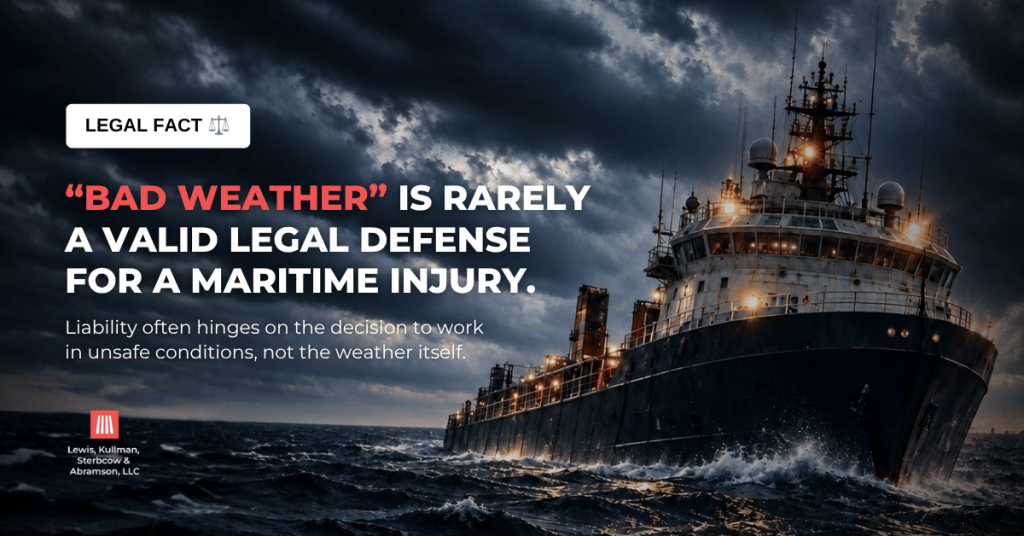
Key Weather Conditions Affecting Offshore and Maritime Workers
The weather at sea is dynamic and ever-changing. This is especially true in places like the Gulf of Mexico, where devastating storms can arise and change course quickly. During these events, maritime workers are exposed to a number of risks that can result in serious injury and even death.
Many weather events can impact maritime safety:
- Hurricanes and tropical storms. The Gulf Coast is one of the most hurricane-prone regions in the United States. These storms can generate high winds, lightning, tornados, and heavy rains that last for days. They not only pose a danger to vessels on the open water and offshore structures but can also cause devastating damage and injuries to port facilities in coastal areas.
- Thunderstorms. Violent thunderstorms can happen at any time of the year but are especially severe during the winter months when cold air blowing in from the Arctic regions collides with the warm, moist air of the Gulf. Unlike hurricanes and tropical storms, which develop over a period of days, severe thunderstorms can occur with little or no notice.
- High winds and waves. High winds and waves can create significant maritime weather risks. Strong gusts of wind can affect the handling and navigation of boats, especially smaller or less stable vessels. Deckhands exposed to high waves face a significant danger of being swept overboard.
- Heavy fog. Fog is another weather event that can result in tragedy. Heavy fog limits visibility, placing vessels at risk of collisions with other vessels, allisions with stationary objects, or running aground.
- Ice and snow. Ice and snow can pose serious risks to vessels at sea. Ice buildup can result in slippery decks, make it hard to work a ship’s rigging, and damage lines and equipment. Collisions with icebergs or sea ice can severely damage and even sink a ship. While ice and snow generally don’t threaten ships in the Gulf, maritime workers exposed to seasonal arctic air blasts can suffer from hypothermia.
Notable Weather-Related Maritime Accidents
History is full of tales about vessels and their crews lost at sea due to storms and other severe weather events.
SS El Faro: Hurricane Joaquin, 2015
A cargo vessel lost when it sailed into Hurricane Joaquin in the Atlantic Ocean. The ship began taking on water and sank with all 33 crew members aboard. The El Faro investigation led to significant changes in USCG weather routing requirements for commercial vessels.
SEACOR Power: Gulf of Mexico Thunderstorm, 2021
The liftboat SEACOR Power capsized during a severe thunderstorm south of Port Fourchon, Louisiana, killing 13 crew members. Federal court appointed LKSA to the Executive Committee of the resulting litigation — one of the most significant weather-related maritime disasters in Gulf Coast history.
Alexander L. Kielland: North Sea, 1980
Severe winds and high waves caused the anchor cables of the Norwegian drilling rig to break, capsizing the rig and killing 123 workers. This was one of the deadliest offshore disasters in history.
Seacrest Drillship: Gulf of Thailand Typhoon, 1989
The Seacrest drill ship capsized during a typhoon, killing 91 crew members. The disaster highlighted the vulnerability of drilling vessels operating in typhoon-prone waters without adequate storm routing protocols.
Your Legal Rights After a Weather-Related Maritime Injury
Two federal laws protect most offshore workers injured in weather-related accidents. Which one applies to you depends on your job classification and where you were working.
If you are a seaman working on a vessel — the Jones Act applies.
The Jones Act gives you the right to sue your employer directly for negligence. In a weather-related case, negligence means your employer knew or should have known conditions were dangerous and failed to protect you by ignoring weather forecasts, ordering operations to continue in deteriorating conditions, or failing to provide adequate safety equipment. The employer’s negligence need only play the slightest part in causing your injury to support a claim. You can recover medical expenses, lost wages, lost earning capacity, and pain and suffering.
The Jones Act is codified at 46 U.S.C. § 30104 and applies to seamen who spend at least 30% of their working time aboard a vessel in navigation contributing to its mission.
If you work on a dock, platform, or fixed offshore structure — the LHWCA or OCSLA may apply.
The Longshore and Harbor Workers’ Compensation Act covers dock workers, harbor workers, shipbuilders, and ship repairers injured on or adjacent to navigable waters. Workers on fixed offshore platforms on the Outer Continental Shelf are typically covered by OCSLA, which extends LHWCA benefits offshore. Unlike the Jones Act, these laws provide federal workers’ compensation benefits rather than the right to sue for negligence — but they cover medical expenses, rehabilitation, and lost wages regardless of fault.
What you can recover in either case:
- Maintenance and cure :daily living expenses and medical treatment from the date of injury, owed by your employer regardless of fault
- Current and future medical expenses
- Lost wages and lost earning capacity
- Pain and suffering (Jones Act only)
What Employer Negligence Looks Like in Weather-Related Cases
When an offshore worker is injured in a weather-related accident, the legal question is not whether the weather was dangerous. Under the Jones Act, the employer’s negligence need only play the slightest part in causing the injury to support a claim.
Common forms of employer weather negligence in Gulf of Mexico cases:
- Ignoring weather forecasts: Supervisors who order operations to proceed after receiving adverse weather forecasts — or who fail to check available forecasts before departure — may be liable for resulting injuries.
- Failing to halt operations: When weather conditions deteriorate during an operation, the employer has a duty to halt work until conditions are safe. Continuing basket transfers, crane lifts, deck work, or vessel transits in worsening sea state is negligence.
- Inadequate storm preparation: Vessels and platforms operating in the Gulf of Mexico during hurricane season must have documented storm preparation plans. A vessel caught unprepared in conditions that were forecast is evidence of employer negligence.
- Ignoring worker concerns: If a crew member raised weather safety concerns and was told to continue working, that is direct evidence of employer disregard for worker safety. Federal law protects workers who refuse unsafe work.
- Failing to provide weather monitoring equipment: Vessels operating in Gulf waters must have access to current weather information. Operating without functioning weather monitoring equipment is a Jones Act negligence factor.
The SEACOR Power capsizing demonstrated how quickly a severe thunderstorm can turn fatal in Gulf of Mexico waters. LKSA’s court-appointed role in that litigation gave our attorneys direct insight into how employer decisions in deteriorating weather conditions become legal liability.
Frequently Asked Questions
Talk to an LKSA Attorney About Your Weather-Related Injury Claim
LKSA has represented offshore workers injured in weather-related maritime accidents throughout the Gulf Coast for over 35 years. Our attorneys were court-appointed to the Executive Committee of the SEACOR Power litigation — one of the most significant weather-related maritime disasters in Gulf Coast history — giving us direct experience with how employer decisions in deteriorating weather conditions create legal liability.
If you were injured in a maritime accident caused by adverse weather conditions, the first question is whether your employer’s decisions contributed to what happened. LKSA attorneys will evaluate your case for free.